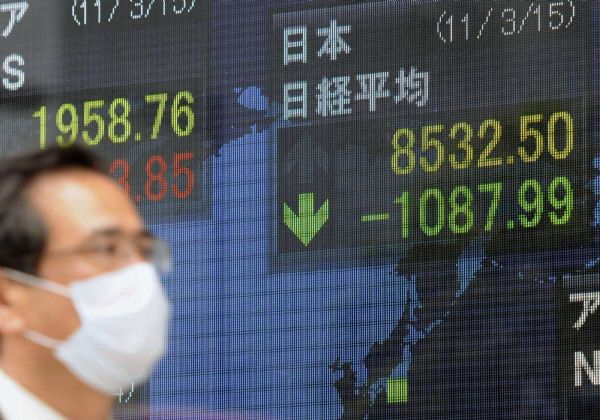
A man walks past a screen displaying stock prices in Tokyo March 15, 2011. Japan's Nikkei share average plunged 10.6 percent on Tuesday, posting the worst two-day rout since 1987, as hedge funds bailed out after reports of rising radiation near Tokyo. (Xinhua/Reuters) "The earthquake and tsunami severely damaged the Japanese economy, but our economic power and technical capabilities have not been shaken at all,'" Edano told reporters earlier on Tuesday. But while the government has been trying ardently to placate global concern about the level of impact that Friday's record quake, tsunami and now nuclear calamity will have on Japan and the wider global economy, leading economists are painting a very different picture. If the past two day's activities on the country's stock market are indicative of what's to come, the government may be wiser to shoot straighter dice rather than sugar-coat the economic impact, economists said. A broad-range of panic-selling, spurred by news radiation was leaking from the stricken nuclear plant in Fukushima Prefecture, sent the 225-issue Nikkei Stock Average plunging 1,015.34 points to close at 8,605.15 on Tuesday. This was the first time the index has ended more than 1,000 points lower since October 16, 2008, when the Lehman shock pummeled global markets and Tuesday's close marked the third worst one-day plunge in the Nikkei's history. Tuesday's nose-dive follows a 6.18 percent drop logged Monday and the index has fallen nearly 17 percent in just two days. Yet, Economic and Fiscal Policy Minister Kaoru Yosano remained composed about the drop, simply saying that the government itself could go into the markets to help pick up the slack. "It is a little bit early to mention, but we should remember that there is such a measure," Yosano said to the press on Tuesday. "Should the equity market keep tumbling, Japan's central bank may increase its purchases of risk assets under its asset-buying program," said Norio Miyagawa, senior economist at Mizuho Securities Research and Consulting Co. in Tokyo. "But if stocks continue to drop more and the yen gains further, it will probably have an adverse effect on corporate sentiment and household consumption. So the BOJ may need to take further action, " Miyagawa said. , |
 |